Book a briefing
See pricesBook a briefing

Evidence search, quoted from the source

A clinician asks a clinical question. Sona searches PubMed, reads the best abstracts and answers with claims that each carry the paper's own words, checked word for word. No source, no answer.

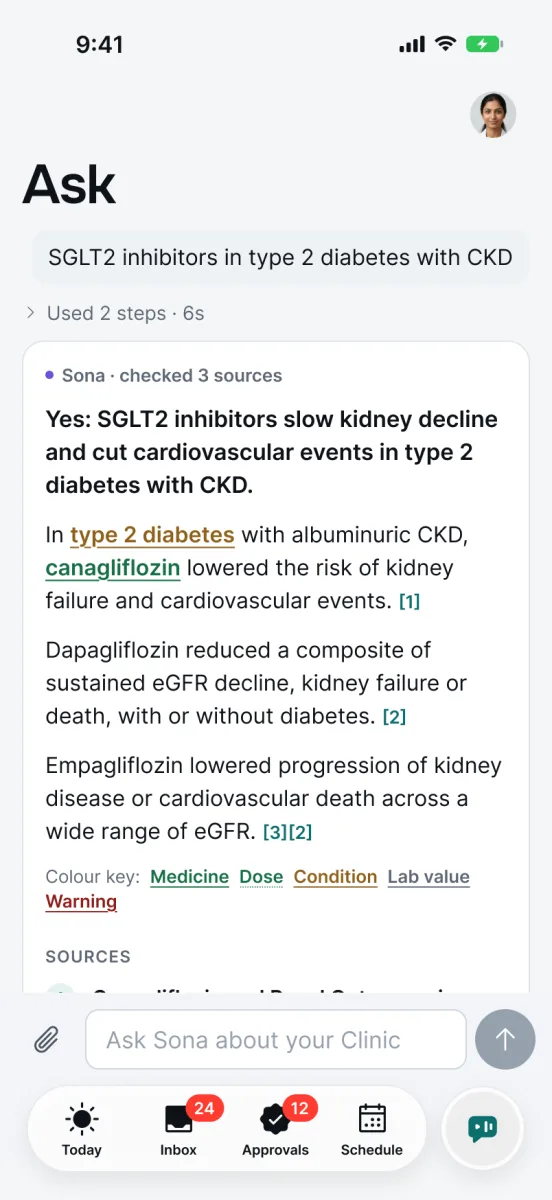
SGLT2 inhibitors in type 2 diabetes with CKD

Sona · checked 3 sources

Yes: SGLT2 inhibitors slow kidney decline and cut cardiovascular events in type 2 diabetes with CKD.

  1. In type 2 diabetes with albuminuric CKD, canagliflozin lowered the risk of kidney failure and cardiovascular events.1Quote found in source 1
  2. Dapagliflozin reduced a composite of sustained eGFR decline, kidney failure or death, with or without diabetes.2Quote found in source 2
  3. Empagliflozin lowered progression of kidney disease or cardiovascular death across a wide range of eGFR.32Quote found in source 3

For clinicians. Evidence summary, not a diagnosis.

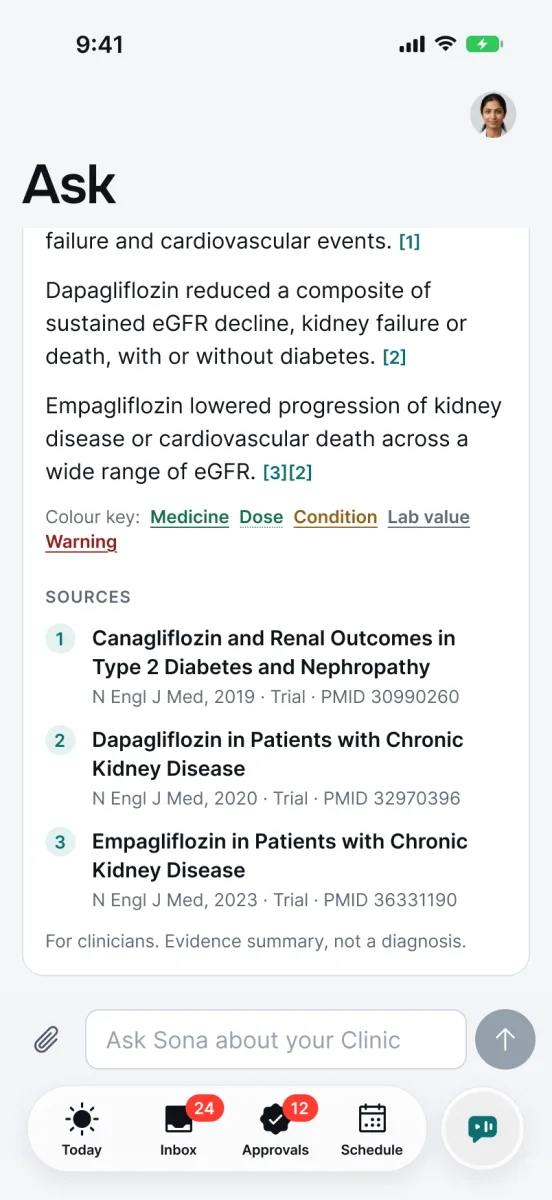
1N Engl J Med, 2019 · TrialPMID 30990260

Canagliflozin and Renal Outcomes in Type 2 Diabetes and Nephropathy

CONCLUSIONS In patients with type 2 diabetes and kidney disease, the risk of kidney failure and cardiovascular events was lower in the canagliflozin group than in the placebo group at a median follow-up of 2.62 years.

2N Engl J Med, 2020 · TrialPMID 32970396

Dapagliflozin in Patients with Chronic Kidney Disease

CONCLUSIONS Among patients with chronic kidney disease, regardless of the presence or absence of diabetes, the risk of a composite of a sustained decline in the estimated GFR of at least 50%, end-stage kidney disease, or death from renal or cardiovascular causes was significantly lower with dapagliflozin than with placebo.

3N Engl J Med, 2023 · TrialPMID 36331190

Empagliflozin in Patients with Chronic Kidney Disease

CONCLUSIONS Among a wide range of patients with chronic kidney disease who were at risk for disease progression, empagliflozin therapy led to a lower risk of progression of kidney disease or death from cardiovascular causes than placebo.

Rebuilt from Sona Pro's sample answer; the marks show the quote check it runs. The abstracts are the real PubMed conclusions. The question is a demo suggestion about no patient.

How it works

From a question to cited claims

Ask from a Visit with "Ask the evidence", or in Ask Sona. The answer comes from what PubMed returns, never from the model alone.

  1. Ask in plain words

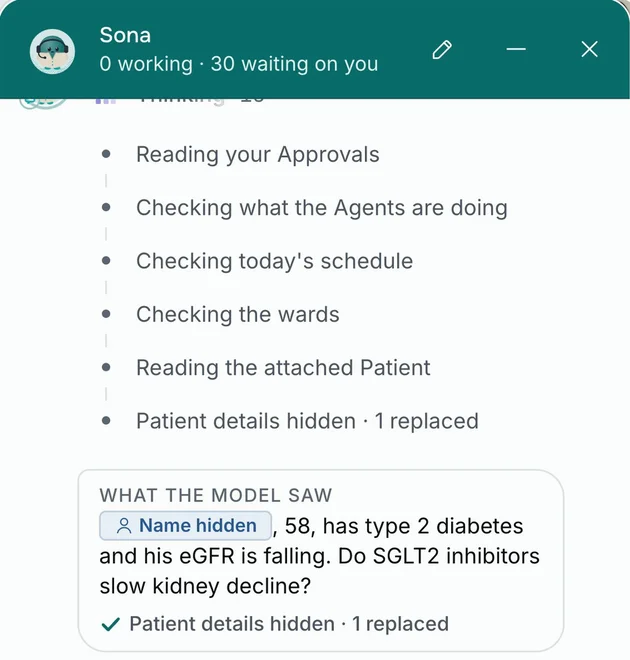
    Clinicians and clinic admins can ask. Attach a patient and the model sees their conditions only, with the name hidden. PubMed never sees a name, MyKad, phone or record.

    Ask Sona in Sona Pro: the steps it took, Reading the attached Patient and Patient details hidden, 1 replaced, then what the model saw: Name hidden, 58, has type 2 diabetes and his eGFR is falling. Do SGLT2 inhibitors slow kidney decline?
    Sona Pro, what the model saw. The patient's name is hidden.
  2. PubMed, best evidence first

    Up to four search terms, ranked so guidelines and reviews come before single trials. Up to five abstracts are read.

    Two terms, as sent to PubMed
    type-2 diabetesckd

    (type 2[tiab] AND diabetes[tiab]) AND (chronic[tiab] AND kidney[tiab] AND disease[tiab])

    Read first
    1. Guidelines
    2. Systematic reviews
    3. Meta-analyses
    4. Randomised trials
    The query Sona's own tests expect for these two terms. No names, only keywords.
  3. Every claim needs its quote

    Each claim cites numbered sources and quotes them. Code checks each quote word for word against the abstract. A claim without one is dropped, and with no claim left there is no answer.

    A claim, and the quote it gave

    Always start one.

    "Every patient must start an SGLT2 inhibitor today."

    Not in the abstract it cites. Dropped.

    No claim left, so no answer.

    A case from Sona's own tests.
  4. The answer, with its sources

    A bottom line, the cited claims and each source with its journal, year and a PubMed link. Every answer ends "For clinicians. Evidence summary, not a diagnosis."

    Ask in Sona Pro on iPhone: the evidence answer's last claims with citations, then Sources: CREDENCE, N Engl J Med 2019, PMID 30990260; DAPA-CKD, 2020, PMID 32970396; EMPA-KIDNEY, 2023, PMID 36331190; and For clinicians. Evidence summary, not a diagnosis
    Sona Pro on iPhone, the sources under an answer.

What clinicians see

An answer, or an honest no

When PubMed has good sources, the answer cites them. When it has none, Sona says so instead of writing one.

Clinician, Sona Pro on iPhone

Ask in Sona Pro on iPhone: SGLT2 inhibitors in type 2 diabetes with CKD. Sona checked 3 sources, a bottom line in bold, and three claims with citations 1, 2 and 3

The bottom line first, then each claim with its numbered sources.

Clinician, when nothing comes back

Tongkat ali for fatigue

No good sources came back from PubMed for this question, so there is no answer.

For clinicians. Evidence summary, not a diagnosis.

Rebuilt from Sona Pro's no-sources sample, with its own words.

4search terms at most, sent to PubMed
5abstracts read at most for one answer
22 to 25 sfor an answer on staging
12questions a minute for each clinician

Guardrails

Sourced, or silent

  • Never from the model alone

    Every claim stands on a quote found word for word in a cited abstract. With no sources, or no quote that checks out, there is no answer.

    Evidence search, quote check
  • Clinicians and clinic admins only

    Front desk, billing and patients are refused. An answer is never sent to a patient.

    Evidence search, roles
  • PubMed gets keywords, nothing else

    No name, MyKad, phone, record or problem list goes to PubMed. The model sees an attached patient's conditions only, with the name hidden.

    De-identification, then PubMed search
  • Labelled on every answer

    "For clinicians. Evidence summary, not a diagnosis." It informs your judgement; it does not replace it.

    Evidence answer, notice
  • Logged without the words

    Each question is audited with who asked and the PMIDs used. The question and answer themselves are not kept.

    Audit log, evidence.ask
  • Plain about its limits

    It searches PubMed in English by keyword, without MeSH headings, and reads abstracts, not full papers.

    Evidence search, PubMed E-utilities

See a clinic day, run by Sona

A working session for your front desk, clinical and finance leads, with a pilot scope for one department.

Book a briefing See prices